Manual · Strongholds
Castles and Domains
Every castle is a fixed domain: size, terrain, wealth, and walls that capture never changes — income, local reserves, and regional recruitment flow from it.
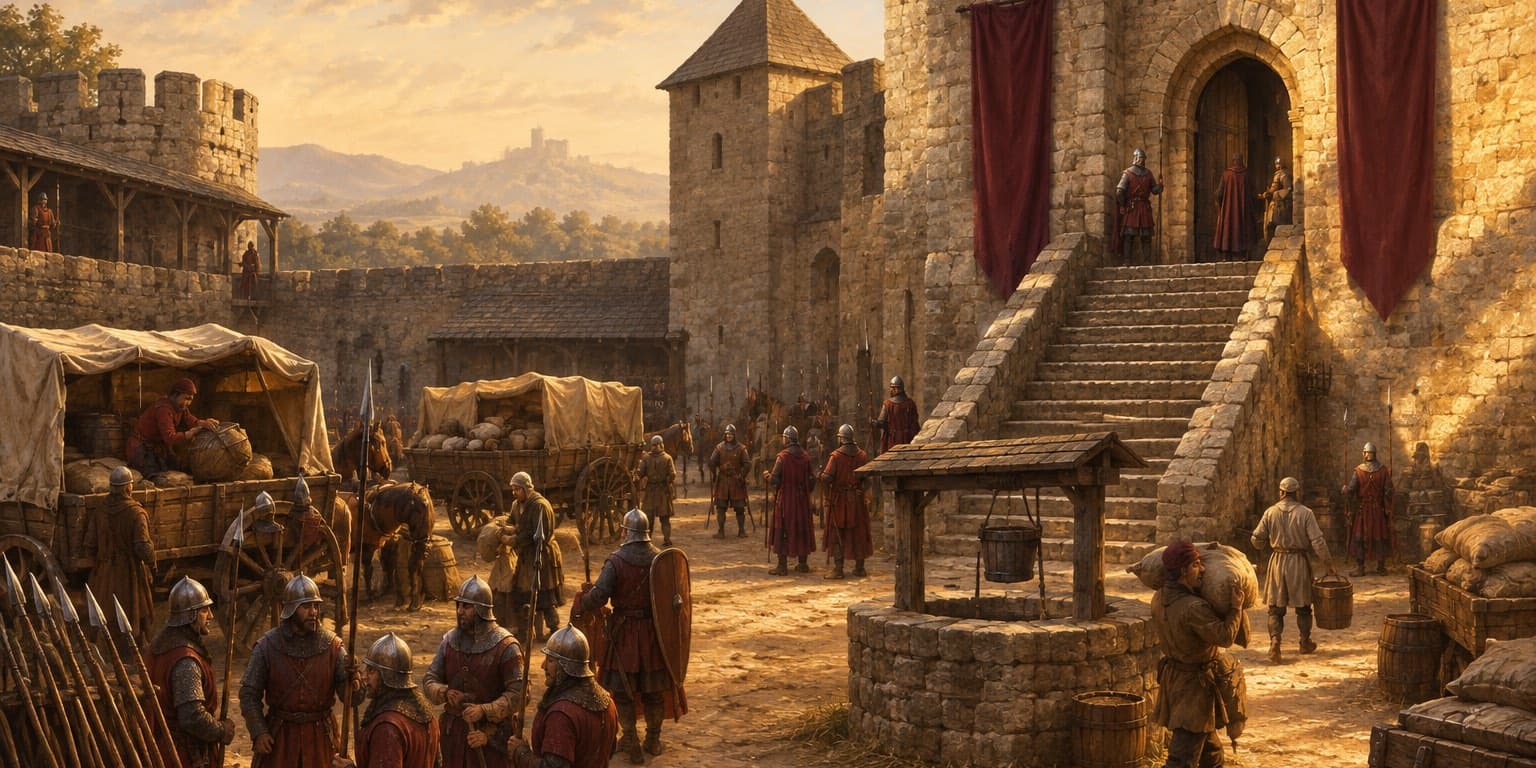
How it works
What a castle is
Each castle is a fixed domain: a size, the terrain around it, its wealth, and its walls — set when the world is made and never changed by the war. Capture transfers ownership, never identity: a taken castle trains exactly what it always trained, pays what it always paid, and shelters behind the same stone.
There is nothing to build and nothing to raze. The strategic question a castle asks is fixed for the whole campaign: who should hold this ground, and what does holding it let you raise?
The war economy
War income comes only from secured castles, paid automatically at your turn start: a fixed gold by the domain's size, plus a little for fertile land and more for trade — a crossing connection or an authored port — with the bonuses capped per location.
That income against your formations' upkeep is the war ledger. An empire of unsecured conquests pays nothing; a compact realm of secured, wealthy domains can out-earn a larger rival. Securing is therefore not paperwork — it is the economy.

Local reserves and regional recruitment
Each castle musters from local reserves — a pool of formations per troop type, sized by the domain. Every muster order consumes one formation from its pool; a secured castle slowly recovers each pool between musters. The land decides the specialist types: woodland domains raise Archers, pasture domains Cavalry, and every domain raises Footmen and Engineers.
So the recruitment map is the strategic map. Woodland and pasture castles are specialist objectives — worth taking for the troops, worth denying for the same reason — while every secured castle anywhere keeps the universal spine coming.
Walls and defence
A castle's defence is its fixed walls and the fightable ground they make: when the castle is attacked, the battle opens on a fortress field of walls, gates, and a keep yard, and every defender — garrison and visitors alike — fights in it. Defended ground inside a town shelters its defenders, and a capital's walls shelter harder than a market's.
A garrison contributes presence and supply, not strength; the walls contribute the strength. See Sieges and Engineers for how an attacker answers them.
Losing and retaking
An undefended castle is taken simply by moving onto it; a defended one must be beaten first. Either way the capture begins unsecured — it pays nothing, recovers nothing, and musters nothing until your companies stand to it across owning turns.
Because identity never changes, retaking a rich domain you lost restores exactly what you lost — and a rival holding your specialist woodland is denying you Archers with your own trees.
Rules, exactly
Exact values from the current build — not advice, not flavour.
- Income by size
- 30 / 45 / 60 gold — small / medium / large, paid at your turn start — secured castles only
- Wealth bonuses
- fertile +5 · trading +10 gold — one location's bonuses cap at 15 gold
- Reserve capacity
- 2 / 3 / 4 formations per troop type — small / medium / large; every muster order consumes one formation from its pool
- Reserve recovery
- 1 formation per troop type every 2 turns — at a secured castle, between musters