Manual · Armies
Companies and Banners
How formations become armies: companies, grouping under one banner, combining, garrisons, standing marches, and supply.
How it works
What a company is
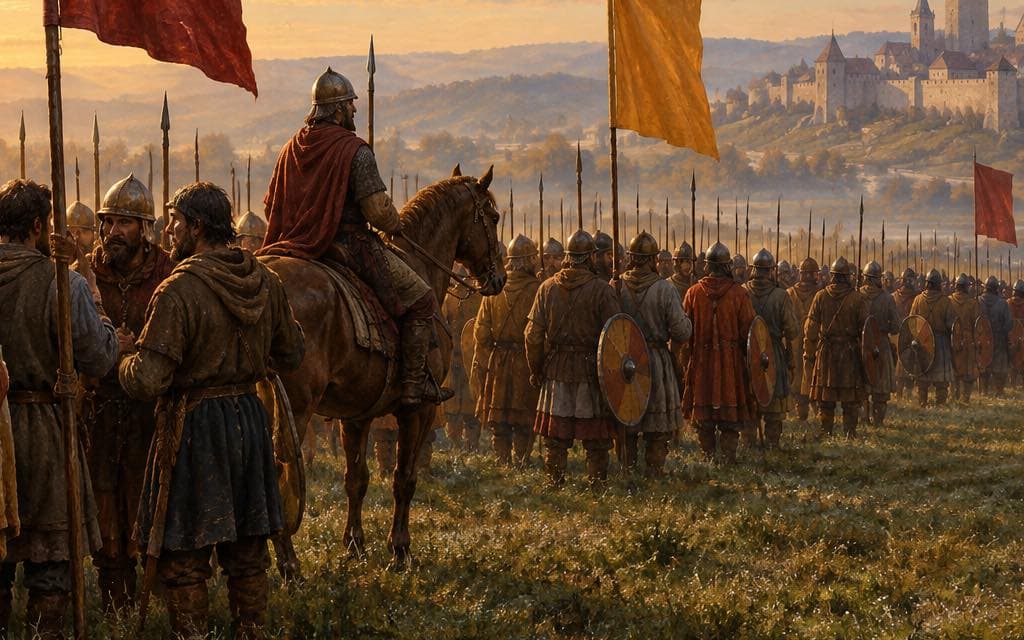
The company is the unit of command: one banner, a fixed ceiling of formations, moving and fighting on one order. Recruits deploy into the company you name when you muster them; every formation keeps its identity, rank, and wounds for as long as it lives.
Companies may share a hex freely and pass through friends; only hostile forces block ground. What a company does — march, fight, stand — is felt by every formation in it, which is why organization is a weapon: rest, supply, and garrison duty all attach at the company level.
Banners and groups
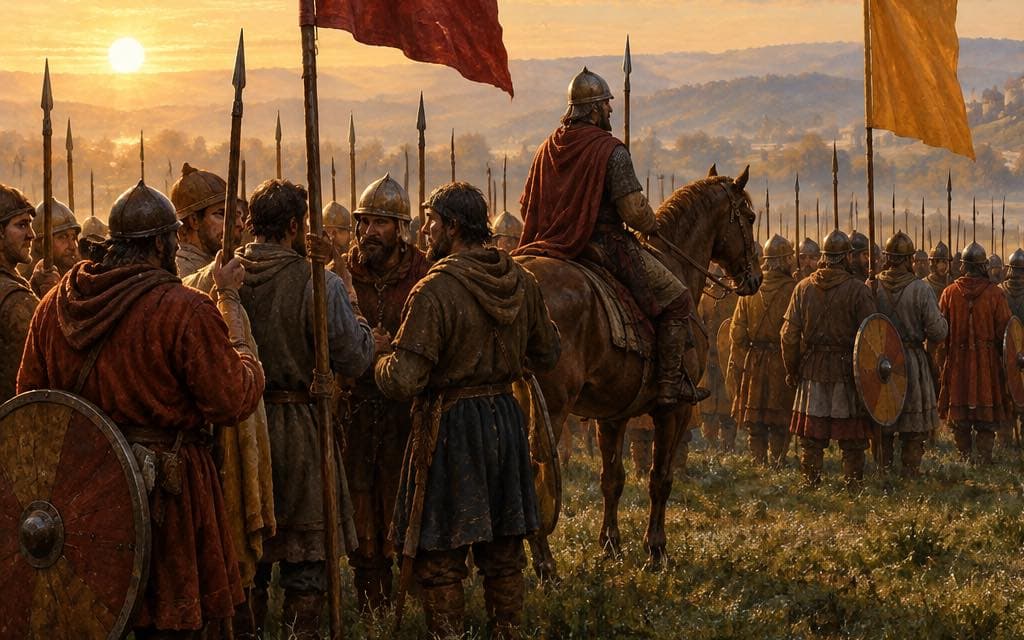
Colocated companies can group under one banner. Selecting any member commands the whole, and it moves on a single order — every member pays its own route cost, and the slowest sets the pace. Detach a member or dissolve the banner at any time.
Grouping grants no combat bonus and never refreshes movement: it is a convenience of command, not a formation of troops. In battle each formation fights under its own activation regardless of the banner it marched under.
Combining and transferring
Combining is different from grouping: it empties one colocated company into another in a single order, so only the survivor remains. Every formation keeps its identity; the emptied company is disbanded. It is how you knit two wounded companies into one fighting whole.
Transfers redistribute formations between colocated companies. A transfer sets both companies to the lower of their movement — troops do not teleport — and a split-off company inherits its source's pace. Use them to build a fresh banner without stopping the war.
Garrison duty
Garrison duty is explicit: a company standing in one of your castles can be assigned to hold it, and it stays until released. A garrison must be released before it can march or join a banner; visitors come and go without disturbing it.
When a castle is attacked, every defender — garrison and visitors alike — fights in the same battle. Garrison status itself grants no strength: protection comes from terrain, defended ground, and the castle's fixed walls. What the garrison contributes is presence — and supply, while the castle stands stable.
Standing marches
A destination beyond one turn's movement becomes a standing march: the force advances one further leg each time you end your turn, and Cancel march withdraws only the remaining journey. The dock beside End turn counts the forces still marching.
The route shown assumes the world stays as it is; a standing march replans each turn if ground or garrisons change. A march that cannot safely progress holds in place with the reason on the company's panel — and at a hostile destination it stops on safe ground and waits for your order to give battle.
Supply
Supply follows the roads. A force on the road-and-settlement network with an unbroken route to a stable friendly castle is supplied; an enemy shadowing the route makes it tenuous; off the network, or severed by hostile ground, it is cut off — and a cut-off force marches slower until it mends its lines.
Supply never immobilizes: even cut off, a force keeps a reduced allowance and can fight its way back to its own ground. A garrison is supplied by its castle whenever that castle stands stable. Cut-off forces in a bad way may even find their next battle a breakout — see Battles.
Rules, exactly
Exact values from the current build — not advice, not flavour.
- Company ceiling
- 12 formations — the limit is per company; grouping binds no extra companies and hexes may be shared freely
- March allowance
- 3 points per turn — a grouped banner pays every member's route and moves at the slowest member's pace
- Cut-off allowance
- 2 of 3 points — a force severed from its supply network marches slower, never immobilized
- Tactical field cap
- 12 formations per side — the battlefield ceiling; further formations wait as reserves