Unit deep dive · Armies
Cavalry
Shock riders — the charge lands harder on open ground than anything else in the war, and nothing on the field moves faster. Dearest to raise and keep, and raised only at pasture domains.
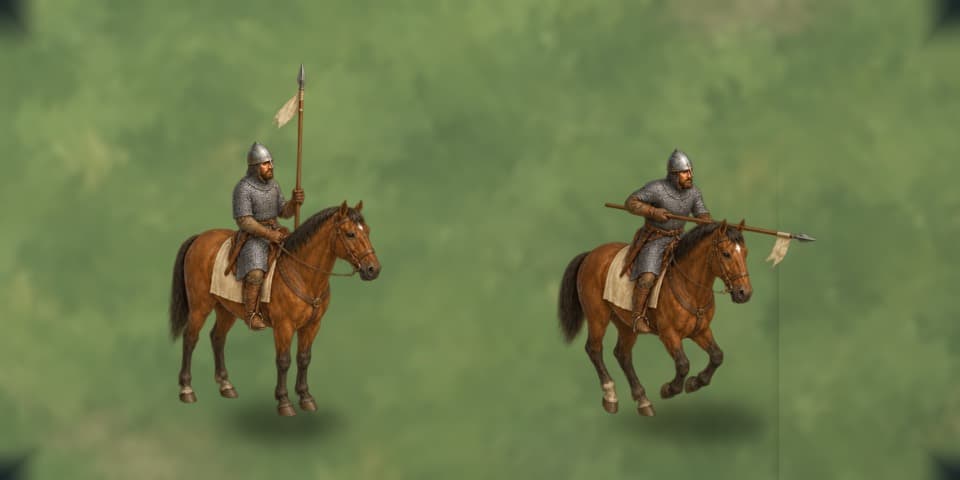
What it is
Cavalry are shock riders: horsemen raised from pasture domains, held for the moment a line breaks or a flank stands naked. They are the fastest thing on any battlefield and the heaviest blow in the open — and the most expensive habit a treasury can keep.
Why it matters
The charge
A Cavalry formation charging home across open ground hits harder than its own attack suggests — the charge itself adds weight no other troop brings. From the Seasoned rank the charge is scaled and lands harder still, and at Elite a rider may strike and slip away in the same breath, once a battle.
But the charge is a promise with conditions: it belongs to open ground only, it must be delivered at arm's length, and a braced line of Footmen robs it of everything extra. Cavalry decide battles against the unsteady and the unscreened; against a settled shield wall they are just expensive infantry with better retreats.
Masters of the open field
On the battlefield nothing matches their pace — they close, they flank, they reach the Archers. That speed is a strategic weapon: formations that cannot refuse a fight against riders must be screened by troops who can hold one.
They come only from pasture domains, take longer to muster than any other troop, and their wage bill is the war's highest. A cavalry arm is a commitment, not a purchase: field them where the ground and the moment reward them, or spend the same gold on two lines of Footmen.
How it works
Arms and the mount
Their craft is the ridden blow: lance or sabre delivered at speed, the horse itself half the weapon. In the rules this reads as a strong attack and a middling defence — riders hit like a line formation but do not stand like one, and once the charge is spent or denied, they fight as ordinary melee troops.
The mount gives no armour class and no special resilience; what it gives is the charge bonus on open ground and speed, nothing else. Against gates and walls cavalry are nearly useless — the charge earns nothing there, and riders batter timber worse than anyone but Archers, who cannot batter at all.
Mobility
The campaign march is the great leveller: on the road, a company of riders moves no faster than a company of Footmen, and a grouped banner paces itself to its slowest member. Cavalry dominance is tactical — on the field they move farther per activation than any other formation, which is how they pick their fights and refuse bad ones.
The Elite rank's post-attack withdrawal extends that: strike, then step one hex clear, once per battle. It is an escape and a repositioning tool, not a second charge — the step never claims objective ground.
Resilience and recovery
A fresh formation enters at full health like any other; their defence sits below the line's, so a fight they do not finish quickly goes against them. Wounds scale their outgoing damage as for everyone — and replacements are the war's dearest: cavalry strength returns only through replenishment at a secured castle with pasture, and their upkeep never pauses for pity.
Readiness bands and rest behave exactly as for the rest of the army. What differs is the temptation: riders are the formations most often spent chasing a beaten enemy into a bad position. A shaken cavalry formation recovers on rest like any other — if it survives the mistake that shook it.
Strengths and vulnerabilities
Strengths: the open-ground charge at every rank, scaled from Seasoned; battlefield speed no one matches; the Elite's strike-and-step-away; and a strong base attack even where the charge is denied.
Vulnerabilities: the braced line, which turns the charge off entirely; broken ground, which never lets it happen; walls, where they fight as plain melee and batter worse than Footmen; and the ledger — highest upkeep, longest muster, pasture-only recruitment. A cavalry defeat costs more than any other kind of defeat.
Open ground and its denials
The charge demands open ground on both sides of the blow — the hex ridden from and the hex ridden into must both be open, with no wall between. Fields and crossings are open; woods and hills are not, and both also hand the defender cover.
So cavalry terrain-doctrine is the mirror of the Footmen's: seek the open, avoid the rough, and remember that a crossing is open ground — a charge over a bridge is legal and lethal, which is why holding one is serious work.
Deployment and combinations
Pair cavalry with a line that fixes: Footmen hold the enemy front, and the riders decide where the real blow lands — a flank, a battery of Archers, a gate party caught in the open. Against enemy cavalry, open ground becomes a duel of screening and patience; against a braced line, ride elsewhere.
They excel at punishing mistakes: a formation that advances alone, Archers without a screen, an engineer company frozen at its work. In a fortress assault, leave them outside or on the approach — inside the walls their whole advantage is spent.
Common mistakes
Charging the shield wall. A braced Footman formation takes the charge's whole edge away, and the riders are then in a melee they do not win. Second: expecting the road to bend to the horse — campaign marches run at the common pace, so cavalry cannot outrun a pursuit or a retreat between battles.
Third: feeding them through the rough. A charge that starts or ends in woods or hills is no charge at all. And last, the quiet one: the wage bill. Riders kept standing idle in a garrison cost the same as riders at war, and an army that cannot pay sees every formation's readiness — the expensive ones first missed — erode band by band.
Rules, exactly
Exact values from the current build — not advice, not flavour.
- Recruitment cost
- 100 gold — paid when the muster order starts, consuming one formation from the castle's local reserve
- Upkeep
- 6 gold per turn — fielded, garrisoned, and mustered troops waiting at the walls alike
- Muster time
- 2 turns — owning turns of work; the troops then wait ready at the walls
- Raised at
- Pasture domains — the castle's domain must carry the pasture tag
- Base attack
- 4 — campaign base at Recruit (L1); effective battle damage also reflects rank, the defender's defence, terrain, and wounds
- Base defence
- 3 — campaign base at Recruit (L1); ranks raise it in battle (see Rank growth)
- Tactical movement
- 5 hexes per activation — fields and crossings cost 1 to enter, woods and hills 2
- Attack range
- Adjacent
- Retaliation
- 60% of normal damage — a surviving melee defender's counterstrike, once per enemy side-turn
- Gate battering
- 1 structure damage per activation — against the marked gates of a fortress assault
- Battle health
- 10 — a fresh formation; readiness and strength scale entry health
- Ranks
- Recruit (L1) → Elite (L5) — a rank's threshold is lifetime experience; Elite holds 850 XP
- Rank growth
- attack ×1.00 → ×1.20, defence ×1.00 → ×1.10 — level multipliers on the Recruit base, per Trained (L2) upward
- Outfitting gold
- 40 gold / 70 gold / 120 gold / 200 gold — by target rank Trained (L2) → Elite (L5), paid with a promotion
- Paid training
- reaches Seasoned (L3) — 0.8 gold per missing XP point; higher ranks are earned in battle only
- Open-ground charge
- +2 attack, every rank — charging an adjacent formation across open ground — both hexes fields or crossings, no wall between; a braced defender negates it entirely
- Scaled charge
- from Seasoned (L3) — the open-ground charge bonus is multiplied ×1.25
- Post-attack withdrawal
- at Elite (L5) — one free hex step after an attack, once per battle
- Readiness bands
- Ready 10 · Shaken 8 · Depleted 6 — entry health per band; battle survivors classify by final health, and beyond 1 turn of unpaid wages each further unpaid turn drops every formation one band
- Readiness recovery
- 1 band per resting owning turn — resting is idle in a stable friendly castle, or supplied and idle in the field; it is free and never restores strength
- Replenishment
- up to 25 strength points per owning turn — only a replenishment order at a secured castle that raises cavalry; gold and local reserve pay for what is restored, and rank is untouched